Our Freshmen Military Training About to Begin

Quite a few teachers in China enjoy teaching freshmen.  Whether high school or college, there are always  perks to having 1st year students when they arrive at their schools for the first time.  Everything is new for them:  classes, teachers, friends, the educational environment.  Their excited attitude of a fresh start makes teaching these young people so much fun.

But there’s yet another bonus for teachers:  Freshmen start 2 weeks later than upper classmen, meaning teachers of these students won’t have a full teaching load quite yet.

Why the 2-week late start?

China’s Mandatory Basic Military Training Course

In China, a 2-week military training period is required of all incoming freshmen, both high school and college.

While upper classmen are busy at work with regular classes, the freshmen are dressed in their spanking new camouflage uniforms, marching about campus in careful formations and learning how to work together as a unit.  Their instructors are soldiers from the area’s local army base, which sends representatives to lead the students in their daily drills.

Aside from correct marching techniques, soldiers give lectures on proper upkeep of dorm rooms (spick and span!), daily life expectations, love-of-country  and how to get along with one another.

The content of the basic training depends on the instructors and their base criteria for a civilian student training course.  A few training courses even teach students how to shoot rifles, but for the most part, it’s just a lot of marching about while chanting drill slogans all day in the hot sun.

What’s the Purpose?

            These mandatory courses began for college freshmen in the mid-1980s, followed as a requirement for high school freshmen in the 1990s.   Most foreigners look at this as a means of controlling students, instilling a strong sense of patriotism for school and country with a lot of fervent, gung-ho army chants and strict disciplinary measures.

My take is that it was meant to instill a sense of unity and camaraderie among students who, for the first time, are far from home and in need of guidance. Independence and individual resourcefulness are not traits found in most Chinese young teenagers or college students.  They need help in dealing with upheavals and sudden changes in their lives, such as moving to a new school where dialects are different and surroundings very unfamiliar.

To maintain some sort of stability, a military training course keeps them busy for the first 2 weeks.  They have no time to think about family or how lonely they are.  They can’t go away and hide in the library or their dormitory rooms, feeling sorry for themselves.  They have to complete the course, meaning being surrounded by classmates all day and bonding in a way which otherwise wouldn’t take place if they were just left alone.

Quite a majority of Chinese students I’ve talked to say that the freshman basic training course was tiring and  tedious, but they were glad they had to do it. It brought them closer together as classmates and helped them adjust to a new family life, that of their school.

Our School’s Training Delay

Here at Guangxi Normal University for Nationalities, incoming freshmen are also required to do their military training course at the beginning of the school year.  After arriving in late August, they usually begin their 2-week requirement before even stepping into the classroom as a college student.

But Longzhou is so far south, with the weather in the high 90s (even 100s) in September, that the school officials decided to postpone the course until the spring semester, when it’s much cooler.  Their idea was to have the training course in March, as soon as the students returned after their winter holiday break.

Unfortunately for us, the nearby army base was training its new recruits in March.  They had no spare instructors to send over until they finished with their own soldiers.

With that announcement, we have all been waiting impatiently to hear when exactly our 1st years will be able to complete their mandatory requirements.

Since a majority of my students are freshmen, I’ve especially been anxious about when I’ll lose my classes for 2 weeks.  Every week, I’ve been told it’ll be next week.  And yet next week arrives, and I’m still teaching everyone.

I did scramble successfully to complete all my Easter lessons, and even managed to set up my Easter displays in my home.  We missed out on classroom egg-coloring, however.  I just didn’t know when to schedule those in, which is a shame as I’m sure everyone would have enjoyed it.

Uniforms Arrive!  Maybe Next Week?

           This past week, there’s been a lot of buzz around the campus and among the offices that perhaps the freshmen are ready to begin their basic training course, starting Monday.  No official word has come down yet from the higher-ups but students did get their uniforms 2 days ago.

When I entered the classroom to begin my 10:30 a.m. lesson, my freshmen English Education majors were hyped.  They all had their crisply folded, camouflaged uniforms and were trying them on.  Cap, pants, jacket shirt and plastic belt were included in the set.  In other schools I’ve been in, flimsy, thin-soled, green canvas shoes were thrown in but not here.  Students had to wear their own tennis shoes, which is just as well.  Those cheap training shoes wore out in a hurry.

Everyone was pretty much in an uproar as it seems one size fits all.  The uniforms were humongous!  The pants were 2 or 3 sizes too big around the waist, thus the absolute need for the belt.  Otherwise, you’d be losing your trousers.

Yet another rather annoying fact was that they stunk.

My entire room reeked of pesticide-sprayed, factory clothes that came fresh off the assembly lines.   The stench was awful and about made us all sick.

“I bet I know what you’re all doing after class today,” I announced to the group.

Not missing a beat, everyone said, “Go back to the dorms and wash our uniforms!”

It wouldn’t be so bad except these things cost money.  Each student was required to pay 150 yuan ($23) for their military training attire.  They’ll most likely use the clothes for 2 weeks and then discard them.  Not only are they too big, but the material is sticky, stiff and very hot.  I’m not sure what they were made out of but it certainly wasn’t a very nice weave of comfortable cotton.  Even after washing, I’m not sure they’d be very desirable or pleasant to wear.

Connie’s Plans for the Military Training Course

For myself, once the freshmen begin their training, I won’t be having their classes.  I do have the 2nd years, but in between, I’ll have nothing to do.  With that I mind, I decided to get some necessary business done.

Since all foreigners are required to have an annual physical to extend their visas for a year,  I’ll be doing that in Nanning.  The process is 3 days, with the physical taken one morning and the results picked up 2 days later.

My plan is to leave with the dog to Nanning and have that done, once the official announcement comes down from above that the freshmen are, indeed, starting their basic training course next week.

Until then, it’s still wait and see.

Here’s wishing you Ping An ( peace), and blessings, for your weekend!

This slideshow requires JavaScript.

Posted in Uncategorized | Leave a comment

A Saturday of Visitors

Coloring Eggs with the Kids

            For those that follow my website, you already know that Saturday afternoon is my time with the neighborhood kids.  I have an open door policy from 3 p.m. to 4 p.m. every Saturday for those children who want to hang out in the foreigner’s apartment.  I have regulars who come often and then those that pop in for a visit every couple of months.

            We put together puzzles, play with the remote car, enjoy snacks and sometimes do holiday activities.

            What holiday is fast approaching?  It’s Easter! And what makes Easter fun?  Egg coloring!

            Yesterday afternoon had those present coloring eggs.  Amy, Joe and Annie were my only visitors, meaning that they had a lot of eggs to take home in their Dollar Store Easter bags. (I made sure to stock up on those years ago in the US and I still haven’t used them all.)

 Dinner with Bill

           That evening, one of my 1st year students, Liang Jinbao(whose English name is Bill), came over for a lesson in US table manners. 

            Bill is quite the keen language learner, visiting the English Center daily to practice his conversation skills.  He recently won our school’s Master of Ceremonies (MC) contest and was offered the job to MC our upcoming English Language Singing Contest.  This was such a hit with the students last year that we’re having another one.  Both a Chinese language MC and an English language MC will be present, translating one another’s banter and introductions for judges and audience alike.

            Bill had a choice, to be in the contest as a singer or to MC it.  With some guidance from me, he decided that being the host is a better opportunity to gain experience in English public speaking and quick-thinking skills in our language.  Thus he’ll be in front of the crowds when the competition takes place.

            For our evening together, I set the table as we would in the States and waited for Bill’s arrival.  Being a thoughtful guest, he brought flowers (3 fresh carnations) which immediately went on our table as our centerpiece. 

            He also brought jiaozi (dumplings) and a raw-fruit salad from a nearby seller at the back gate.  This comprised our meal for the night.

            After receiving instructions on how to use the knife and fork, as well as napkin etiquette, Bill dug in. 

            As his Emily Post, I would have to say he did an excellent job for his first time handling the entire process of dining American style, which included not only table manners but conversational skills as well.  It’s not easy to eat politely while talking.  In China, we usually just hunker down to the eating part without saying much of anything.  Lip smacking, slurping, open-mouth chewing, and spitting bones onto the table or floor is quite common in China. 

            None of that at Connie’s table, that’s for sure!

            So here’s a toast to Bill, for being brave enough to ask for lessons and even braver still for eating under his foreign teacher’s critical eye. 
            Well done!  You’d make any American host or hostess proud.

            Ping An (peace) from Longzhou.  Here’s wishing you a great weekend!

This slideshow requires JavaScript.

Posted in Uncategorized | Leave a comment

“清明节来了!Qing Ming Jie Laile!” (Tomb Sweeping Festival is Coming!)

           Qing Ming Jie (Tomb Sweeping Festival) arrives on April 5.  This is one of China’s newer official holidays, having been declared as such 3 years ago. 

            Before, Tomb Sweeping Festival was merely a traditional day that was not on the list of holidays given to workers and students in China.  Its long history focused on remembrance of those who’ve passed before us.  It was set aside for families to honor their ancestors, visiting gravesites to clean the area of weeds, light special incense called joss sticks (“joss” means a Chinese image or house idol in a shrine) and burn paper money for their loved ones to spend in heaven.  Those with no gravesites to attend to (such as city dwellers) merely gathered together for the usual customs celebrated in their areas. 

            Yesterday, one of my students told me in his village, everyone had to kill a chicken and prepare noodles to offer to those who had died.  After praying and bowing to their hastily-created table altar, on which was placed the lifeless, plucked chicken and pile of noodles, the family then took away the offerings to cook for the family dinner.      

            As mentioned before, Tomb Sweeping Day was never a holiday.  Most people who had moved from home had to wait for weekends to return to hometowns for such events.

            But that all changed when the May 1st holiday (7 days off) was cut to 3 days.  My guess is that it was thought that giving the Chinese more holidays spread out over the year was better than just lumping a holiday all together, giving entire week.  (Interspersed holidays also allow for more  touring opportunities and holiday shopping ventures, thus boosting the economy.)

           With the May holiday reduction, the government went searching to find replacements.  They did so by changing traditional Chinese days to holidays.   Mid-Autumn Festival (late September or early October), Tomb Sweeping Festival (April 5) and Dragonboat Festival (sometime in June) were then added to the sanctioned “1-day-off” list.

 The Make-up Day Custom

             Yesterday was Saturday, which usually means no classes but on this particular weekend, our classrooms filled with the usual lessons due to Qing Ming Jie.

            Although only 1 day is given, most offices and schools create a make-up day on Saturday or Sunday in order to allow a 3-day holiday to emerge. 

            This year, our make-up day was Saturday. 

            All across China, government workers, educational institutions and companies  worked yesterday to make up for a day off on Monday.  On our campus, our Monday classes were all moved to yesterday, allowing students to have Sunday to Tuesday off.

            Yet our school is one which is quite remote.  Students wishing to go home have little time to get there and  back in the allotted 3 days.   So for us in little, far-away Longzhou, an extra day has been given.  Our Wednesday classes have been canceled, much to the delight of the students. 

            A surprising 4 days off is now in effect with classes resuming on Thursday.

 A New Holiday Hype:  Longzhou in the full swing of things

            What happens when a new holiday emerges?  Well, what happens in any country:  Commercialism!

            Before Qing Ming Jie was declared a holiday, Tomb Sweeping items mostly included the usual fragrant joss sticks, paper money, traditional Chinese gold ingot paper chains and white, tissue papered ribbon-strip decorations to be placed on top of graves.   (White in China is the color for death, unlike America where it’s black.)

            But now, commercialism has taken hold.

            Longzhou’s narrow outdoor market street is now overrun by hastily erected booth tents, selling all the fanciful decorations your deceased loved one desires.

             The idea is that by burning images of things, the dead can enjoy these in heaven.  

          Specially printed, fake money  has always been the traditional gift to burn as the dead can buy whatever they choose in their heavenly shops.   For the devoted family member here, a 3,500 yuan stack of fake, paper bills costs 1.5 yuan in our market, roughly 14 cents3,500 yuan is about $500 US.   Sending your late grandma or grandpa, mom or dad  a dollar’s worth of fake money would certainly allow them to live quite well in the afterlife.

            But if you’d rather purchase a “real” item yourself to send off to heaven, there are a lot to choose from.  Paper-made houses, cars, watches, cellphones, and clothes are to be had as well, ready to be ignited at the grave and whisked off into the hands of the deceased. 

            When I cruised our local market, I was astounded by all the cool Tomb Sweeping purchases available.

          A nicely-appointed, furnished house?  60 cents!  A lovely pair of traditional shoes, your choice of men’s or women’s?  45 cents!  Watch, cellphone, ring and necklace set?  40 cents!  Tissue-paper wardrobe, including appropriate colors for each sex?  30 cents!

            It was fascinating to see how a simple tradition had erupted into a full-blown spending spree by, and for, the living.  

           Naturally, wealthy, sophisticated city folk would splurge on more luxury items to burn than your average countryside farmer.   One article I read out of Shanghai included such paper joss purchases as an 18 yuan ($3.00) cosmetic set (lotions, lipsticks, eye shadows, facial cleansers, and fancy bra), not to mention bottles of wine and laptops.      

            In our little town, we have no such posh offerings by our sellers.  People here from the countryside mostly stick with basic needs of the average person, and that’s what’s filling our market tents in Longzhou.

 Any True Believers in These Tomb Sweeping Tradition?

            Do people actually believe such things?  That by burning money or items, their ancestors and recently departed can enjoy these things in the hereafter?

            Perhaps hundreds of years ago, yes.  But in today’s modern society, no, not really.

            “It’s just something we do,” my students tell me.  “A tradition.  A way of remembering our family members who are no longer with us.”

            I follow with the Chinese:  A very unique, time-honored tradition but no truth to it.  

            Yet you have to admit, the idea itself is quite intriguing.  What a pleasant thought that you could actually give gifts to those you love who are no longer on this earth!  Who among us wouldn’t delight in the imaginary figure of great Aunt Corrie or Grandpa James receiving your thoughtful items, smiling and waving to you in gratitude from heaven?

            Kind of comforting, . . .  for a dismissed Chinese superstition. 

            Even I, in all my logical, faithful Christian reasoning, couldn’t help but buy a few Tomb Sweeping knick-knacks from one of the sellers.  Mostly, it was in appreciation to her for allowing me to take as may photographs of her wares as I wished.  However, I must admit, in the back of my mind, I was thinking, “You know, Grandma Marie would really love to wear that flowery, purple tissue dress for Easter.”

        Have fun cruising our Longzhou market in the below slideshow!

      From Connie in Longzhou, here’s wishing you Ping An (peace) for your day. 
This slideshow requires JavaScript.

Posted in Uncategorized | Leave a comment

Guangxi Amity Teachers: A Farewell Gathering in Nanning

             In the past few years, there haven’t been as many Amity teachers as there once was.

             In 1986, when the program first began, the numbers were well into the 40s and 50s.  Now is a different story. Sending agency budget cuts, inability for people to commit to 2 years of service in China (mostly due to personal economic issues), and lack of  PR work in our separate countries have seen the program shrink. 

            This year, we only have 21 teachers, and a majority will be leaving China at the end of the term.

            That  includes many in our Guangxi Province clan.

 Our Amity Guangxi Teachers

            For two years, Guangxi has had 5 Amity teachers placed in different parts of this province:  Claire Brook (UK, in Qinzhou University), Bob Kenyon (UK, in Hezhou University ), Ueli Walter (Switzerland, in Hezhou University), Lena Aspfors (Sweden, in Yulin University) and myself (USA, in Guangxi Normal University for Nationalities).

            Claire and Ueli both came with their spouses, who supported their venture in China for 2 years as staunch supporters.  Claire’s Martin found time to teach in a middle school near the college.  Ueli’s Johanna (from South America) spent her time learning Chinese and English, as well as tutoring students in Spanish.  Both Ueli and Johanna were the youngest in our group (in their 30s) and newlyweds to boot, which always made for great teasing on the part of those in Amity who had long-since tied the knot.

            Since we are so far away from one another, getting together isn’t easy. It’s always a challenge to find a weekend when no one is busy but March 24-26 had us together in Nanning, the capital city, where we were able to catch up, over-indulge in Western food and say our farewells.

            There just isn’t any time for us to meet again this semester, so this was our last opportunity to say goodbye.  Only Lena and I will be staying on in this province next year.  The rest are moving on with their lives in their separate countries.

 A Fun Time Had By All

            As the closing slideshow suggests, everyone made the most of the weekend.

            A Pizza Hut luncheon had us all so hyperactive on caffeine from the restaurant’s rich, dark coffee that no naps were needed that day.  We walked around a nearby teahouse park enclosure to take pictures and ended up enjoying a free tourist show of Zhuang nationality dancers.  Claire announced that during the weekends, the traditional Chinese garden was full of  brides and grooms, dressed to the hilt, having their pictures taken by professional wedding photographers.  

            Sadly to say, there were no such couples on the day we were there.  The weather was just too dark, chilly and dreary to entice anyone out for wedding photos.

            However, a cluster of elderly had set up stools for sketching the scenery around us.  Ink pens, chalk and water colors in hand, they scrutinized the covered teahouse bridge before us while their artistic abilities took over.

            This small drawing club of retired folk certainly were enjoying themselves.  While their talent wasn’t up to any high standards, it wasn’t meant to be.  This was just one of the many different club activities the elderly in big cities partake in year-round.  Whether it’s drumming teams, dancing troupes, tai chi gatherers, gardening green thumbs, calligraphy experts, drawing or painting amateurs, the Chinese older folk know how to keep busy, energetic and active in their retirement years.

            Unlike most of us sedentary, overweight Americans, TV is not their favorite form of relaxation. The Chinese elderly are always on the move, and their well-kept figures prove it, too.

Departures Made Amid Quick Goodbyes

                Sunday morning had a majority of the group already well on their way to return to their colleges.  Ueli, Bob and Johanna had a 7-hour bus ride far to the north.  Claire and Martin had a shorter, 2-hour journey to the south by train.  Lena headed to the east for a 2 ½ hour bus ride to Yulin.  I was scooting in the opposite direction, to the west on my 3-hour trip back to Longzhou.

            Next semester, Lena and I hope enough Amity teachers will be sponsored to fill the spaces our jolly band has filled for 2 years. 

            It’s always a little sad to see old faces leave our ranks but it’s also exciting to have new ones to replace them.   Be sure you’ll have updates on our new teachers here in our province.

Until that time, here’s a toast to our departing teachers:  God Bless and 一路平安 (literally translated as “One road, safety or peace” or rather in English “Safe Travels”).

This slideshow requires JavaScript.

          From Connie in Longzhou, Ping An (peace) for your weekend!  


Posted in Uncategorized | Leave a comment

Did Our Little Longzhou Join in on Earth Hour?

           Sunday morning had me wondering why the electricity was off. 

            Last year, we had constant 12-hour blocks of electricity outages at this time of year. Rumors had it that new power lines were being placed around the town so that’s why we had such things occur.  All I remember is having to cancel my Easter egg-coloring sessions with some of my classes because in the evenings, we couldn’t see to color the eggs.  That and not being able to use the TV or microwave the entire day.  Plus no hot showers as my water heater runs on electricity.

            This year has seen very few such instances of no-power.

            So it was surprising that for about 1 hour Sunday morning, beginning around 10 a.m., the campus went “dark,” sending everyone outside with nothing better  to do but hang out with one another.

            Little Flower and I likewise left our cozy, warmish apartment to venture out under the chilly, overcast skies.  Walking was better than sitting inside, shivering because our little floor heater couldn’t be turned on.  It’s been a cold week with no sunshine and night temperatures dipping into the high 40s.  Very unusual for southern China, where last year we soared into the 70s and 80s.

            Now on the Net, I find that Earth Hour was in effect just about the same time when our electricity went off.

 World-wide Earth Hour Events

          Earth Hour began in 2007, a movement founded in Sydney, Australia by the global environmental group WWF.  It was meant to show the power of a single act when people came together – a united front, reminding people to commit to an action, large or small, that they will carry on through the year to help the planet.   

            That unified act was turning off your lights for 1 hour.

            According to Earth-hour executive director and co-founder Andy  Ridley, 134 countries or territories took part in the event this year. 

           In China, Hong Kong’s neon waterfront dimmed.  Beijing’s 2008 Olympic Bird’s Nest also went dark for an hour as well.

            The article I read continued detailing further Earth Hour moments.

            Sydney’s Opera House was the first of many global landmarks to go dark as the event got under way.  Hundreds of millions of people prepared to follow suit to enhance awareness of energy use and climate change. The London Eye ferris wheel, Times Square in New York and Brazil’s Christ the Redeemer statue likewise joined in.

            Moscow  turned off floodlighting on more than 70 buildings and bridges.  In Athens, monuments being darkened included the Acropolis, the parliament building, the presidential palace and the temple of Poseidon near the city. In Italy, more than 200 towns and cities took part. The Ponte Vecchio in Florence, the Tower of Pisa and the Colosseum in Rome all turned off their lights for an hour.  In Argentina, Buenos Aires switched off the spotlight on its landmark Obelisk.  In Paris a minute’s silence was observed for Japan as the city of light went dark, with illuminations switched off at the Eiffel Tower, Notre Dame cathedral, City Hall, opera houses and many bridges, fountains and public places.

            Even in Japan, still suffering from the effects of the earthquake and tsunami, Earth Hour was recognized.  Several thousand people and a hotel-turned-evacuation center in the northeast went dark to mark the hour.

 Earth Hour Here or Just a Fluke?

            And then we have our little Longzhou, where our Sunday morning 1-hour matched that of yours going off Saturday evening at the same time.

            Did we knowingly participate in Earth Hour or was it just a fluke that our campus power went out for 60 minutes Sunday morning?  Who can say?  But it did get me to wondering, and reading, and thinking about our excessive use of power in the world and small ways I can help here in China. 

            So fluke or not, at least for one person in Longzhou, some awareness has set in.   Now, I need to make sure to follow through.  

              Ping An (peace) for your day, and don’t forget to turn off the lights when you leave the room!

Posted in Uncategorized | Leave a comment

Prices in China Rising . . . And Quickly!

The American Candy Queen

           Wherever I am in the world, it’s always been my habit of purchasing candy.  Whether for classroom prizes, snacks for visitors or just for my own severe sweet tooth, candy can always be found in my presence. 

            And there’s no place better to get candy varieties than in China. 

            For wedding parties, candy is handed out by handfuls to guests or scattered on tables during the marriage dinner. 

            For student gatherings, it’s likewise tossed onto classroom desks while performances abound in front of audience members.

             Chinese New Year brings everyone out in droves for their candy fix, loading up on bags of the stuff to share with family and friends who drop by, bringing good wishes.

            And for myself, the American Candy Queen, it’s just a necessity to always have heaping candy baskets in my home for guests or on hand to lavish upon those in the English Center.  In-class prizes for answering questions or volunteering to perform dialogues is yet another great use of my candy stash. 

            Since students rarely enjoy such treats on their own, the cost being a bit high, candy is a much-appreciated treat.

 Candy on Longzhou’s Inflation List

           So imagine my surprise when I went candy shopping  to find our prices per pound had increased . . . yet again!

            When I first arrived in Longzhou, the many candy sellers in the market were vying for customers.  They had huge varieties of individually wrapped selections piled into bins.  The beautiful shiny wrappers (gold, deep purple, vibrant blue, metallic green) were a big draw.  Each seller had at least 15 different containers of candy, some even more, which we could choose from by loading into a bag for weighing.  The cheap candy sold for 4 yuan (60 cents) a pound.  The more expensive (fancier wrappers and usually chocolates) were 8 yuan ($1.20) a pound.

            And if you were to go for the extravagant, big name-brands found in the Long Jia Supermarket, you went even higher:  $1.70 to $3.00 a pound.

            After several years of holding to the same price, last summer had us go up an entire 14 cents per pound, making it 5 yuan.  When I asked, the sellers told me it was due to the bad sugarcane crop in the area.

            But yet again, another jump has come after only 6 months. 

            My first week back to school after the holidays, I went to load up on  candy supplies from my favorite sellers to find we are now 6 yuan (90 cents) a pound for the cheap stuff and 10 yuan ($1.50) for the other.

             Meanwhile, in the grocery store, prices seem to have remained the same although that might be changing soon.

Gas Goes Up as Well

           And candy prices weren’t the only things that took a hike while I was gone.

            My first shopping day back in Longzhou, I managed to have quite a heavy load on my hands. The bag was overflowing to the point where I decided to take one of our local 3-wheeled mini-cabs back to the campus rather than walk. 

           Mini-cabs are the best transportation as they’re cheap.  For just 3 yuan (45 cents), you can go anywhere in the town.  It’s been that way for several years, according to the locals.

            When my driver landed me at the back gate, I already had my 3 yuan prepared to hand over.  She took my money and as I scrambled out, she said, “It’s 4 yuan.”

            “4 yuan? It’s always 3 yuan,” I announced with some suspicion.

            I was thinking: Is this driver trying to cheat the foreigner?  Well, good luck on that one!
             “Why is it 4 yuan?” I continued.

            “Higher prices,” she replied. “Gas.”

            Being a cautious individual, I had her wait a moment while I asked our gate attendant.

            “Is it really 4 yuan now for the 3-wheeled cabs?” I asked him.

            He nodded, leaving me to return and hand over yet another 1 yuan for my cab ride.

 Other Goods Will Follow,  Rice Included

            I’m guessing within another year, I’ll be seeing such increases expand to more necessary items than my candy. 

            Rice, for example, is now heading into that category. 

            I asked one student what she spent her hong bao (red envelope) gift money on during the holidays. 

            She replied, “I bought rice for my family, 80 yuan worth (about $12) – 10 pounds.” 

            For a family of 5, they can eat daily on that for a month if they stretch it.

            This reminded me of my former Luzhou student, Jason (Ji Ke), whose parents farm their plot of land and use all the produce for their own consumption.  They harvest 7 months’ worth of rice a year rather than buy it in the market.  That saves them a yearly 700 yuan ($105 US), money that they certainly don’t have to spend in grocery stores on rice.

             Frugal?  Sure, but the time and energy  taken to harvest that amount of rice by hand is not easy.  It’s exhausting labor, stooping outside in the hot sun to tend to the crops,  then having to pluck and dry the rice on roadsides over a period of several days. 

            Fighting the elements is thrown into the mix as well.  Damp, wet weather can ruin an entire rice harvest waiting to dry in the sun.   If a farmer picks the wrong day, with a heavy wind suddenly kicking up to scatter the grains off the tarps or an unexpected rain shower, the family has lost their staple food for the winter.    

            Most farmers also beat out the husks by hand rather than hire someone to use their machinery to do it for them.  Using such equipment is readily available, and quite a few make a good living renting their machines to locals for use, but the majority of farmers don’t waste their money on such things.  They do it all themselves, bringing in willing neighbors and other family members to lend a hand.

Increases Across the Country

           According to a March 11th  article in the New York Times (“Inflation Prices Grow in China” by David Barboza), the consumer price index in China rose 4.9% in February alone.    Also in February, food prices rose by 11%. 

            That news certainly seems to follow what I and others have been experiencing here in little Longzhou.

            And we’re still not finished yet. 

            Barboza’s article explained further:   “Inflation remains at an elevated level and it has not peaked yet,” Wang Qing, a Hong Kong-based economist said. “We think inflation will rebound in April or May and peak midyear.”

            For me, such inflation news is not a big deal.  I have money.  Paying an extra 15 cents for numerous items is not going to cause any dent in my spending sprees.

 Students Unable to Continue with Their Studies

            But for my students and their families, it’s a different story. 

            Already I’ve lost 4 freshmen and 1 sophomore who dropped out of school due to money difficulties.  It’s sad to see their names crossed off my list, especially knowing that I’ll never see them again. 

            My sophomore in particular I miss.  Her English name was Soul, an appropriate name for her quiet, rather sad demeanor.  She was the silent type, rarely spoke in class and kept to herself much of the time.  And yet, after one year of my classes, she began to emerge from her thoughtful shell and take part in discussions.  There were even days when she managed a smile in my classroom!  It truly lit up the room.  I was so proud of her last semester for her efforts, and on many occasions, I told her so.

            Although 1 week late in returning this term, when she appeared again 3 weeks ago, I was happy to see she wasn’t giving up.

            But last week, I was told she left our school and is not coming back.   The burden of tuition is just too great for her family, and her will to study while causing her parents such financial hardship finally overcame her.

            I will miss our Soul in class.  I hope she finds her place in the world where she can be happy and content.

            From Longzhou, China, here’s wishing you Ping An (peace) for your day. 

This slideshow requires JavaScript.

Posted in Uncategorized | Leave a comment

Our Women’s Day Week Ends

Women’s Day Activies Come to a Close

             Our Women’s Day activities end tomorrow, Friday.  It’s been great fun watching the boys proudly stand before the class and hold their special time for their classmates.  From the song to the drawing to handing out favors, the boys did an excellent job.  There was a lot of praise and appreciation that came from everyone, including myself.  We’ll definitely be doing this again next year.

              Here are a few shots from my first year English Education majors, Class 3.  Enjoy, and Ping An (Peace)!


This slideshow requires JavaScript.


Posted in Uncategorized | Leave a comment

Happy International Women’ Day from China!

A Simplified History of International Women’s Day

          International Women’s Day (IWD) began in Europe and America in the early 1800’s.  At that time, in America and other countries, there were great changes as the economy was rapidly developing and becoming more industrialized.  With industrialization, women moved out of their homes and began to work, mostly in factories where conditions were bad and the pay was low.  As a result, women began to form groups to protest the terrible situation of their working places.  They wanted better working conditions and the same salary as men.

            On March 8, 1857, women workers in clothing factories in New York City protested for better working conditions, a ten-hour working day and to have equal rights. 

            Fifty-one years later, on March 8, 1908, women factory workers and members of the Socialist Party in New York City protested again.  This was in remembrance of the 1857 march, the right of women to vote, and an end to sweatshops and child labor. 

            The next year in 1910, the Socialist International Party met in Denmark.  A German socialist named Klara Zetkin asked for a special day for women to be decreed called International Women’s Day  (IWD).  This day was to honor women and their right to be equal with men.  March 8 was chosen as the date.

            Despite its creation in 1910, IWD did not become a world celebration until 1975, when the United Nations declared it an international holiday.

 Celebrating IWD Abroad

          In many countries throughout the world, IWD is considered a big affair.  There are lectures given by women, gatherings to discuss women’s rights, music concerts and a variety of other women-centered events.

            Yet in America, people know little or nothing about this day, even though its roots began in our country.   We do designate March as Women’s Month, but as far as the day itself, it comes and goes with little notice.

             I certainly had not a clue what International Women’s Day was until 23 years ago, when  I worked in Kyoto, Japan at the Kyoto YWCA as an English language teacher.  The staff of  Japanese women carefully prepared for March 8 with a fanfare I had never seen before in my own country.  A large luncheon was planned with notable women speakers  who were well-known for advocating women’s rights. Their topics concentrated on women abuse issues in Japan, targeting the Japanese workplace and household.  

            We also held a Saturday bazaar, with the proceeds going to specific Kyoto projects to help women.

            With this introduction to International Women’s Day, I began to take more notice of March 8.   

            In my teaching placement in Taipei, Taiwan at Wesley Girls’ High School,  we women teachers received individual gifts from the school.  One year, we were given a cheesecake.  Another year, it was 2 pounds of dried pork, presented by one of our students’ fathers who worked in a meat packaging plant.   Yet another year, it was a box of butter cookies from a famous bakery in town.

            To sweeten the day even more, every gift was accompanied by the traditional Chinese gift, the hong bao (red envelope).  This was from the Parents’ Association.  Inside, we found a $100.

            Here in mainland China, I have also enjoyed the benefits of Nu Sheng Jie (Women’s Festival).  As a college English teacher, I find we women are never forgotten by school officials. 

            At my previous college in Sichuan Province, we had an entire day off with a free tour to a cherry blossom park.  We walked about the area, admiring the beautiful flowering trees, chatting, taking pictures and enjoying our complimentary lunch and dinner. 

            The next year, each department prepared performances.  We women were asked by the male administrators to show off our talents in singing, dancing, and acting.

            It sounded like a good idea but the amount of work that went into preparing for our programs was excruciating.  After all our complaints, the next year there were no performances.  Instead, each of our 12 departments was given 800 yuan ($130) to take us ladies out to dinner.

            Now that we appreciated.

 IWD at  My Current College   

        My current teaching placement is in far southern Guangxi, one of China’s 5 autonomous regions and one of the poorer provinces of the country.  Our small, rural college doesn’t have the funding to spend on such lavish Women’s Day presents as big dinners or all-day outings.  Still, despite the tight budget, the administrators made sure that today we received something.  Whether teachers, office workers, cooks or grounds’ maintenance staff, we women each received a hong bao.  The teachers received 80 yuan ($10) while others received 40 yuan ($5).   (Last year, it was 50 yuan and 20 yuan but with inflation, we are benefiting.  A Women’s Day bonus.  Hurrah!)        

            While the gift wasn’t nearly as grandiose as former schools I’d taught in, the gesture from this struggling college certainly outshone that of my former employers.

             The average salary of a rural college teacher here is $260 a month, with the cooks and grounds’ crew receiving about $50 a month.  That little extra money goes a long way in rural China, especially for those who have families to feed.

            Also included in our gifts this year were flowers.  A bouquet of carnations was presented to all women teachers during our break time after the 1st period.  The Student Association members caught all of us having lessons this morning and gave us our flowers.

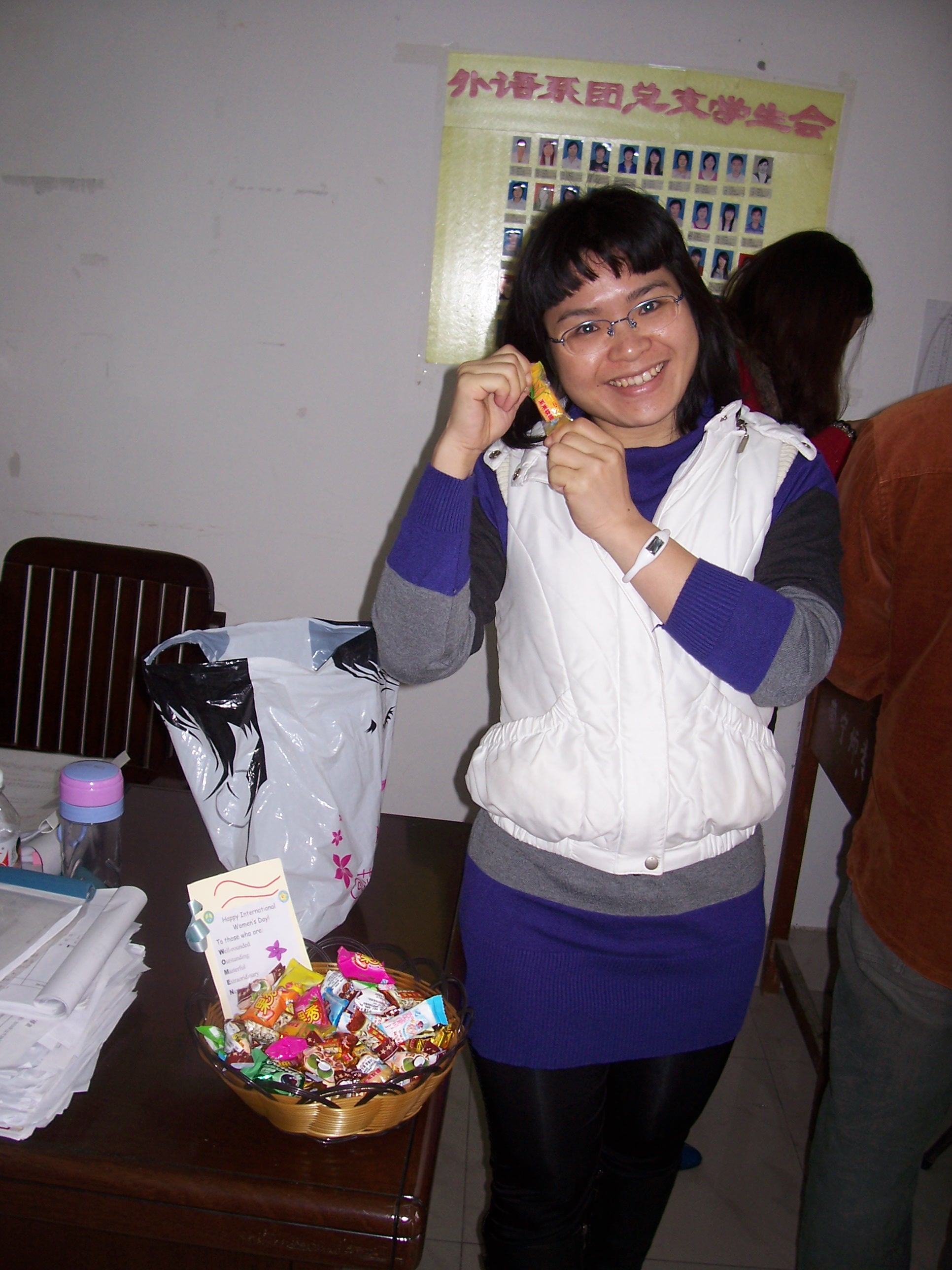
           And in our English departmental office, I also added a little zip to the working atmosphere with a basket of assorted candy and an IWD card.  When I left for my next class, our English teachers were busily picking through the basket, choosing their favorites and gobbling them down with gusto.  

Teachers Enjoying Their Candies

 IWD In The English Language Classroom

          As already mentioned in my previous blog, “Back to Work!  The Semester Begins,” (beside the above listed “Home” and “About “,  click on so-named post to read) I always commemorate International Women’s Day in my English language classroom by making  sure my students are fully aware of this day.  My IWD unit includes a history of IWD, current statistics about women in China and the US and Internet searches done by students on notable American and Chinese women.

            This year, an added element to the unit involved my male students.

            Out of the 270 English language majors I teach, 13 are men.   This follows the trend of most Asian countries, where liberal arts’ study falls mainly to college female populations.   

            To give our women a meaningful day, my 13 guys will be serenading  the ladies in each class and holding a drawing for prizes which they purchased themselves.  They also will be presenting their classmates with handmade favors, which they completed in my home last weekend.

This slideshow requires JavaScript.

            Today, I had the first women students of the week enjoy their special surprises from their male classmates.  In my 2nd year class today, James and Rio went all out with their song, “Happy Women’s Day To You” (sung to the tune “Happy Birthday to You”), and their drawing afterwards.  They certainly had fun on their shopping trips.  Their carefully wrapped prizes included a big bottle of coke, huge lollipops, and instant noodle packets.  

         Each excited winner drawn came forward to give a short speech of thanks and wish everyone a Happy Women’s Day.   Included in their thank yous was always a grateful look in my direction.  

         After class, my new monitor (class leader), Lucy,  approached me privately.

        “Connie, this class is so wonderful!  I have never had such a day like this for Women’s Day.  I really thank you.  It’s so special.  I will never forget it.”

          Ah!  What every teacher wants to hear! 

         So for today, I would say the energy and careful planning by the James and Rio for our special class certainly will make our International Women’s Day an enviable one on campus.  Maybe next year, other departments will follow suit and treat their female students with just as much enthusiasm  as my English major men.

            From China, here’s wishing you Ping An (Peace) and a great Women’s Day.

Posted in Longzhou: Tiny Town on the Li River | Leave a comment

Welcome to My New Website . . . We Hope

Hello, everyone!

As you know from the last posting, MSN’s “My Space” will soon be gone.  Those of us using My Space blogs coud either be transferred (migrated) to WordPress or  deleted.  My choice was to try for Word Press but in China, I could never migrate as the screen would always come up in error.

After returning to the States for my Chinese New Year holidays (January 15 to February 9), I learned that Word Press is blocked in China.  However, using your own domain might work with a link to Word Press.  Thus after paying a mere $25.00 for the entire year, I now have my own domain, connieinchina.org.

Today, I am heading back to China.  Whether I can continue to use this site or not in the country is still going to be a mystery until I arrive.  I’ll cross my fingers that all goes well and you will be able to continue reading about my life and Little Flower’s in little Longzhou.

As for this visit to the States, it’s been packed full of activities.  As a former university swimmer at Eastern Illinois University, I was thrilled to not only attend a home meet at my alma mater in Charleston, IL, but also to swim several times in my old pool during the weekends.  I even met up with my former swimming coach, Ray Padovan, who is now retired, for a walk down memory lane as we chatted about the past.

Another highlight was giving the message in two of our United Methodist churches, one being my home church and the other, the “country” church a few miles from town.  I even made it to the Baptist’s after-school club  to talk about Chinese New Year and my role as an American English teacher and a Christian in the small town, Longzhou. 

 Then we had my brother’s law partner, Joe, who invited me as his speaker for Rotary.  It was a bit of a struggle to get myself up and presentable at 6:30 a.m. but it was well worth it to see many familiar faces and share more about China. 

Of course, there was plenty of time spent with my parents and our little Sichuan street-stray rescue, disabled Lao-lao (Old-old).  He’s been in America now for 1 1/2 years, this being his second Illinois winter.   His former life in Chengdu never had him experience such harsh temperatures or weather conditions.  All this snow and ice  didn’t make our toothless, jawless Chihuahua very happy.    But spring is coming soon so maybe my mother will be able to get him out for his daily walks in another month or so.

My own dog, Little Flower, is currently with her Chinese sitter and I’m sure she’s been suffering as well.  I continued to check temperatures in Chengdu, where she is staying, and saw quite a few days of light snow as well as temps in the 30s.  Most people in Sichuan don’t have indoor heating, merely tiny dual air-con units that don’t do much of anything if turned on, so I can imagine she was shivering away most of the time in her temporary home. 

That’s soon to change, though!  After yet another Net search, I found out that Guangxi Province is now deep into Spring weather, in the 70s by day and 50s by night.  That’s more for us!  I’m sure Longzhou, being far south, is even warmer.  When our college classes start up on February 21st, I’ll be back in my summer clothes again.

Before closing, I just want to welcome all of you to the new site.  Thank you so much for checking in and let’s hope there will be more blogs in the future using this same space.

Ping An (peace!), everyone!

corneliamw@yahoo.com

Posted in Uncategorized | Leave a comment

Happy New Year! (And change of Website)


A Change of Website


           For 2011, I have  learned that My Space is closing up shop.  All My Space blogs are to be moved to a new location.  Beginning January 4, no new blog postings will be allowed.  As of March, all My Space websites will be discontinued.

            At present, I am to move my site to the new location.  Unfortunately, I am having difficulty doing this.  I will try my best but if you don’t hear from me for awhile after this entry, that is the reason.


Generous Funds for Campus Celebrations


            One thing that I’ve always appreciated about this college is the amount of money allotted to student organizations for campus events.  Contests, special performances, celebrations (such as Christmas and New Year’s) and other activities are not cheap.  Sound equipment, stage decorations, and costume rentals for dancers or MCs all cost money. 

            At my previous placement in Sichuan, the school officials rarely parted with the college’s cash.  They held tightly to the funds and refused to dole out even a little for our activities.

            But here is a different story.

           
Ushering in 2011

            Naturally, New Year’s Eve was yet another opportunity for the Student Union to use their organizational expertise to throw a grand showing like they did for Christmas. 
            Announcement boards all around campus caused plenty of anticipation among the students about the big event.

            7:30 p.m. would start  3 hours of stage performances with singers and dancers. 

            8 p.m. the big bonfire would be lit.  Party games with prizes were to continue onward until midnight when there would be a firework display.                               

           After that, free sparklers would be handed out to all present for yet more partying time.  Everything would close up at 1:30 a.m., when the volunteers were required to clean everything up to make for a tidy January 1st.

           It was a detailed schedule and one which we all were looking forward to.


The Bonfire:  “Kaboom!”


            I’m not a big one for stage performances in China, especially as the students singing their pop-song solos are always off-key,  scream into the microphone, and the music is too loud.   It’s not very pleasant to Western ears but the cheering Chinese student fans adore such things.

            However, the one thing I was interested in seeing was the lighting of our bonfire .

            This year, the Student Union volunteers had made the outline of “2011” with split bamboo.  In the halved bamboo, they poured in lighter fluid so when one end was lit, it would race through all the numbers, finally arrowing into the big bonfire.

            For our safety, the volunteers had roped off the area.  We were a good 5 feet back but even then, I had to wonder about what would happen when the flames raced to piles of kindling before us.

            Why was that?

            Well, the lighter fluid used was gasoline. 

            I watched the Student Union members (and it would be the guys, of course) go a bit overboard with the gasoline.  They doused the wood and paper piled on top of our bonfire with a lot of gusto, most likely wanting to make sure we had a flame worthy of the New Year.

            I remember taking a few more steps back, just in case that initial lighting needed a bit more than 5 feet of distance.

            As 8 p.m. approached, the MC shouted excited greetings to all of us as the torch bearers proudly trotted down to light our 2011 numbers.  I had my doubts that the fire would reach the bonfire without a little help.  Volunteers with extra torches lined the roped-off area to make sure the flame continue onward to the bonfire.

            The “2” started to light first.

            The students cheered!

            The fire continued tamely to the “0”, then the first “1", then the second "1".

            Everyone was clapping!

            Then our fire hit the grand prize, the bonfire.

            “KABOOM!!!”

            A huge explosion sent paper and kindling flying everywhere. 

            The surrounding crowd-control volunteers ducked for cover.  We in the crowds rushed backwards.   A gigantic flame shot skyward.

            Wow!  Now that’s what I call a New Year’s bonfire!

            Thankfully, no one was hurt.  The fire died down to nothing just as quickly as it went up. The volunteers then spent another 10 minutes getting it started up again to the point where it would burn all evening.

            After that, our biggest thrill was the firework display at midnight.  We had 15 minutes of non-stop fireworks, lit in their tubes by the students who raced about to give us a lovely show.  In the States, this would have been done by a professional company or the local fire department.  In China, however, it seems anyone can buy firework displays and put them on by themselves.

            The last activity of the evening was the sparklers.  Adults, students, children and even the elderly enjoyed in on their free gift. 

            Aside from the bonfire, I’d say this was yet another dangerous moment with everyone standing so close to one another, wildly waving their sparklers around and even having sword fights with them.  It was a miracle that the college kids, or the little children for that matter, in their overzealous eagerness, didn’t burn themselves.

            But that’s an American’s  way of thinking.  For the Chinese, safety wasn’t an issue, just having fun. And they certainly had fun.


            Happy New Year, Everyone!  Hope your 2011 is a blessed one, and just as much a "blast" as ours was.

            Ping An (Peace) from China


Posted in Tiny Town on the Li River | Leave a comment